
Why You Keep Starting Courses and Never Finishing Them
97% of online learners never finish a course. It's not a discipline problem — it's a structure problem. Here's the psychology behind tutorial hell and how to escape it.
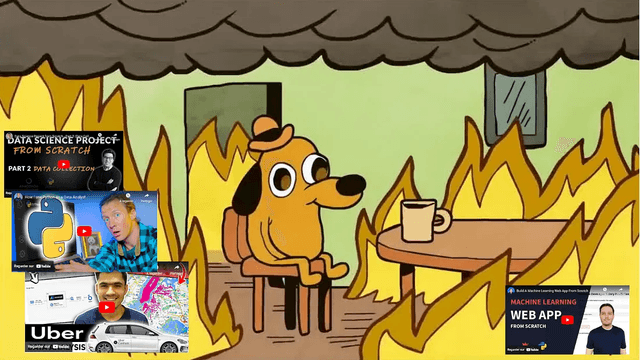
There's a conversation that happens every few months in every developer community, every data science Discord, every career-switching subreddit.
Someone posts: "I've been trying to learn Python for two years. I start a course, get 30% through, then stop. Then I start another one. I have seven half-finished Udemy courses. What's wrong with me?"
The comments flood in. Hundreds of upvotes. Dozens of replies saying "same" or "you're literally describing my life."
What's striking isn't the problem itself. It's how universal it is.
If this were a personal discipline issue, it wouldn't affect so many people. If it were a motivation issue, it wouldn't happen to people who clearly want to learn — people who keep starting over, who spend money on courses, who feel genuine frustration at not progressing.
The truth is: you're not broken. The way online learning is set up is.
This article is about why it happens, what's actually going on in your brain when you abandon a course, and — most importantly — what the research says actually works.
The Numbers Are Worse Than You Think
Let's start with data, because the scale of this problem is shocking.
The average completion rate for a free online course (MOOCs — Massive Open Online Courses like Coursera, edX) is between 3% and 6%. That means if 1,000 people enroll in a course, between 940 and 970 of them will not finish it.
Paid courses do better — but not dramatically. Udemy's internal data suggests completion rates hover around 15-20% for paid courses, meaning 80% of people who spend money on a course still don't finish it.
These aren't outliers. These are averages across millions of learners, thousands of courses, dozens of platforms.
If 97% of people fail to do something, the logical conclusion is not "97% of people lack discipline." The logical conclusion is: the thing is designed in a way that doesn't work.
The 4 Real Reasons You Don't Finish
1. Choice Paralysis Kills You Before You Start
Search "learn Python" on YouTube. You'll find thousands of videos, dozens of full courses, each one promising to be the best, the most complete, the one that will finally make it click.
Search "data engineering roadmap" and you'll get 47 different opinions on which tools to learn in which order, half of which contradict each other.
This is called choice overload, and it's psychologically crippling. A famous study by Sheena Iyengar at Columbia University (the "jam experiment") showed that when people are given too many options, they're not just less satisfied with their choice — they're significantly less likely to make a choice at all.
You don't fail to start because you're lazy. You fail to start — or you start the wrong thing and quickly abandon it — because the decision about what to learn and from where is itself an exhausting, paralyzing task that you haven't been given any tools to navigate.
By the time you've picked a resource, you've already spent cognitive energy that should have gone into learning.
2. There's No Curriculum — Just Content
Here's the fundamental problem with learning from YouTube or a random collection of Udemy courses: content is not a curriculum.
A curriculum is a sequenced, progressive path where each concept builds on the previous one. It has a starting point, an ending point, and a logical structure in between. It has been designed by someone who thought carefully about what a learner needs to know first.
YouTube has none of that. YouTube has individual videos optimized for views, watch time, and search rankings — not for your learning progression.
So you watch a beginner Python video, then a video on machine learning, then a video on neural networks (because it looked cool), then you realize you don't understand gradient descent, so you watch a video on calculus, and suddenly you're three hours deep into linear algebra and you've lost the thread of what you were originally trying to learn.
This isn't a discipline failure. It's what happens when there is no map and you're trying to find a destination.
Without structure, the path of least resistance is to wander.
3. Nothing Is At Stake — So Nothing Pushes You Forward
Think about the things you've consistently shown up for in your life. School. Work. The gym when you had a trainer. A commitment you made to someone else.
What do these have in common? Stakes. Consequences. Accountability.
Now think about a free YouTube playlist or even a €15 Udemy course. What happens if you don't watch the next video today? Absolutely nothing. No one notices. No one follows up. No deadline passes. The course is still there whenever you feel like it — which means "whenever you feel like it" gradually becomes never.
This isn't a character flaw. It's basic behavioral psychology. Human beings are wired to prioritize things with immediate consequences over things with distant or nonexistent consequences.
The gym equipment is free. People still pay for personal trainers. Not because the trainer has equipment you don't have access to — but because when you've paid for Tuesday at 7am, you show up on Tuesday at 7am.
The absence of stakes is not freedom. It's a recipe for procrastination.
4. You Never Know If You're Actually Learning
This is the most underrated problem in self-directed online learning, and it's the one that kills long-term motivation more than anything else.
You watch a video. It makes sense while you're watching it. The instructor explains something and you think "yes, I understand this." You feel the warm glow of comprehension.
Then you close the video, open a blank editor, and... nothing. You can't reproduce what you just watched. You can't apply it. You can't explain it to someone else.
This is called the illusion of knowing — a cognitive phenomenon where the fluency of watching an expert do something creates a false sense that you could do it too. The same thing happens when you read a textbook highlighting every other sentence. The act of reading feels productive. The retention is minimal.
Real learning requires active retrieval — being asked to recall something without looking at the answer. Flashcards. Quizzes. Explaining a concept out loud. Building something from scratch without following along.
When you watch a video without any retrieval mechanism, you might understand it in the moment. But without retrieval practice, most of it is gone within 24 hours.
And when you come back to the next video and realize you've forgotten most of the last one, the experience is demoralizing. Not inspiring. Demoralizing. And you quietly close the tab.
What Actually Works (The Research Version)
Cognitive scientists and educational psychologists have spent decades studying how people learn effectively. The findings are remarkably consistent. None of them involve watching a 4-hour tutorial passively.
Spaced repetition — reviewing material at increasing intervals — dramatically improves long-term retention compared to massed practice ("cramming"). Apps like Anki are built on this principle. Duolingo's streak system is a simplified version of it.
Active recall — retrieving information from memory without looking at it — is consistently one of the most effective learning techniques identified in research. Testing yourself, even if you fail, produces better retention than re-reading the correct answer.
Interleaving — mixing different topics or problem types within a study session — produces stronger learning than blocked practice (mastering one topic completely before moving on), even though it feels harder and less productive in the moment.
The generation effect — trying to produce an answer before seeing it — leads to better memory of information, even when the generated answer is wrong.
Desirable difficulty — making learning slightly harder than feels comfortable — consistently leads to better long-term outcomes than easy, fluent studying.
Notice what all of these have in common: friction. Real learning is supposed to feel hard. If it feels easy, passive, and comfortable — like watching a well-produced YouTube video — you're probably not learning as much as you think.
The Tutorial Hell Spiral
Understanding the mechanism helps. Here's exactly how tutorial hell works as a self-reinforcing loop:
Start a course (motivated, excited)
    ↓
Watch videos passively (feels productive)
    ↓
Don't retain what you watched
    ↓
Get stuck when trying to apply it
    ↓
Feel stupid and frustrated
    ↓
Conclude "this course isn't good enough"
    ↓
Search for a better course
    ↓
Start a new course (motivated again, briefly)
    ↓
Repeat
The cruel trick is that each restart comes with a fresh burst of motivation — which you interpret as evidence that the new course is better, when actually it's just the novelty effect. Novelty produces dopamine. Progress produces real learning. They feel similar for about two days.
The solution isn't to find the perfect course. There is no perfect course. The solution is to change your relationship with learning itself.
What Breaking Out of Tutorial Hell Actually Looks Like
Step 1: Commit to one path before you start
Don't search for resources when you're trying to learn. Search for resources in a dedicated planning session, pick one, and then commit to it for a defined period. Six weeks. Eight weeks. Whatever the course duration is.
The research on commitment devices is clear: pre-committing to a course of action significantly increases follow-through, even when the commitment is entirely self-imposed.
Step 2: Structure the content, not just the content
The resource you use matters less than the structure around it. A mediocre course with a clear schedule, regular quizzes, and accountability mechanisms will produce better outcomes than a brilliant YouTube playlist watched whenever you feel like it.
If you're using YouTube, build your own structure: a module plan, specific videos assigned to specific days, a quiz you write yourself at the end of each session.
Step 3: Kill passive consumption, introduce active retrieval
After every video or lesson, close your laptop and write down — without looking — everything you remember. Then open your notes and check what you missed.
This single habit will double your retention. It feels uncomfortable because you'll realize how little you retained. That discomfort is the learning happening.
Step 4: Put something at stake
This can be money (a more expensive course you've paid for), social accountability (telling someone you're going to learn X by date Y), or public commitment (posting your progress). The specific mechanism matters less than the existence of some consequence.
Step 5: Build something before you feel ready
The single most effective exit from tutorial hell is starting a project before you think you know enough. You don't know enough. You never will. Start anyway.
The gaps in your knowledge become visible only when you try to build something. And visible gaps are vastly easier to fill than the vague sense that you're missing things but you don't know what.
The Real Question
Here's what nobody in the "productivity" space wants to tell you, because it doesn't make for a satisfying YouTube video:
The problem isn't which course you choose. It's the container around learning.
The container is: a structured path, daily accountability, active retrieval, feedback on whether you understood, and something at stake.
YouTube has incredible content. So does freeCodeCamp. So does almost every free resource on the internet. The content was never the bottleneck.
The bottleneck is structure. Accountability. Feedback. The feeling that you're moving forward and can prove it.
When you have those things, almost any decent resource works. When you don't have those things, even the best course in the world will collect digital dust in your Udemy library.
A Different Way to Learn
What if instead of searching for the perfect course, you could specify what you want to learn — your level, how many hours you have per week, what your goal is — and get back a structured, personalized curriculum assembled from the best free content on the internet?
With modules in the right order. Videos that fit your time budget. Quizzes after each lesson to make sure things are actually sticking. A daily streak to keep you showing up. And an AI tutor that has watched the videos with you and can answer the questions you're too embarrassed to ask anywhere else.
That's exactly what we built with CraftCourse.
Not another course platform. Not more content. A structure that makes the free content you'd find anyway actually work.
If you've started and abandoned more courses than you can count, it's worth trying a different approach.
Summary: Why You Don't Finish (And What To Do)
| The Real Problem | The Real Solution |
|---|---|
| Choice paralysis — too many resources | Commit to one path before you start |
| Content without curriculum | Add structure around whatever you use |
| No stakes or accountability | Create a commitment device |
| Passive watching without retention | Active recall after every session |
| No feedback on understanding | Quiz yourself. Build things. Get stuck. |
| Restarting for novelty dopamine | Recognize the pattern and resist it |
The content was never the problem. You were never the problem. The missing piece was always the structure around the learning.
Now you know what to build.
CraftCourse generates personalized learning courses from the best free YouTube videos and articles on the internet — with built-in quizzes, daily streaks, and an AI tutor that actually knows what you just watched. Try it free →
CraftCourse
Ready to learn faster?
Generate a personalized course tailored to your level, goals, and schedule. Completely free to start.
Generate your free course